
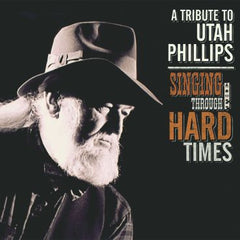
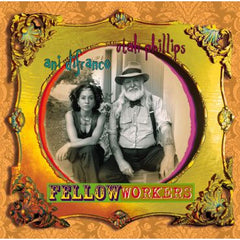
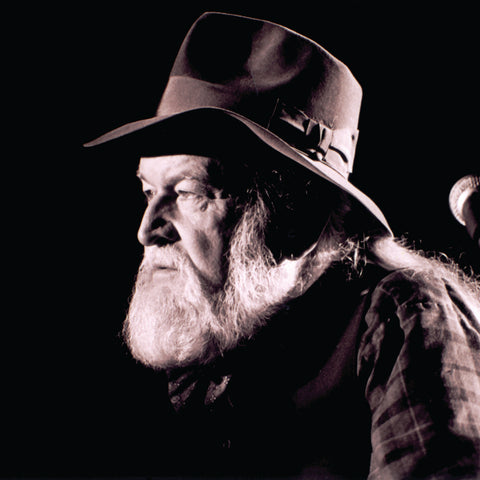
Bruce "U. Utah" Phillips was the fundamental pragmatist who makes stories of any raw material that finds its way into his experience. A former warehouseman in Salt Lake City, he learned yarning from Earl M. Lyman, an elder of the Latter Day Saints and Phillips' employer, who interrupted the morning's wrapping and shipping to tell anecdotes and events of Mormon pioneer days. At the end of a workday, Phillips went to the library to read territorial history to find questions to ask Lyman the next day. Thus Phillips learned the art of storytelling as a way to avoid work. Zuni chants and Navaho songs and lore from Father Liebler, a San Juan priest, plus conversations with hoboes and cowboys, lectures by anarchist and pacifist Ammon Hennacy, and a performance by Marian Anderson during the Korean War, augmented Phillips' store of eyewitness accounts, anecdotes, tales, and philosophy.
Phillips ran away from home in his teens to gain an education on the road, riding the rails and bumming along with tramps. He taught himself to play the ukulele and guitar, and began writing songs about the hobo life while supporting himself as a printer, dishwasher, and stock clerk. His experience during the Korean War convinced him that nonviolence is the only sane way to live. During the 1960s, Utah worked as a state archivist and founded the Poor People's Party in Utah. In 1968, he ran for the U.S. Senate on the Peace & Freedom ticket. A leave of absence from state service turned into permanent dismissal and an opportunity to try his luck as a platform entertainer, sharing his tales and songs with the folk family in the style of a Celtic bard. In 1997 he received both a Lifetime Achievement Award from The Folk Alliance and a Lifetime Service to Labor Award from the American Federation of Musicians, Traveling Musicians Local 1000.
After over 40 years of touring, Utah Phillips died of congestive heart failure in his home on May 23, 2008.
Ride the rails to http://thelongmemory.com/ for more.